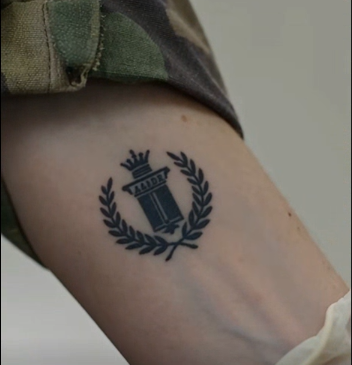
THE CROWN ON HER ARM
The cafeteria fell silent the moment the tray hit the floor.
CLANG!
Macaroni and cheese splattered across the polished tiles. Steamed vegetables scattered beneath the boots of two soldiers. A plastic cup rolled in a slow circle before finally coming to rest beneath a metal table.
Dozens of heads turned.
The woman standing in the middle of the aisle didn’t move.
She was in her late twenties, her dark hair pulled tightly into a regulation bun. She wore a standard camouflage uniform and clear medical gloves, the kind worn by soldiers assigned to kitchen duty.
Nothing about her appearance suggested that she was important.
Nothing except her eyes.
They were calm.
Almost unnervingly calm.
The man standing opposite her was nearly twice her size in width and considerably taller. Staff Sergeant Marcus Hale had spent years learning how to use his physical presence as a weapon.
He knew how to make younger soldiers step aside.
He knew how to make people lower their voices.
He knew how to make fear look like respect.
He looked at the food on the floor.
Then at the woman.
And smiled.
“Watch where you’re going.”
His voice carried across the cafeteria.
“You made the mess. Clean it up.”
The woman looked down at the food.
Then back at him.
“You knocked it out of my hands.”
Her voice was quiet.
“Pick it up.”
Several soldiers stopped eating.
Marcus’s smile disappeared.
He stepped closer.
“Are you absolutely sure?”
She didn’t move.
“Don’t test my patience.”
He leaned toward her.
“Get down and clean it.”
For a moment, she simply stared at him.
Then she said something that would later be repeated throughout the base.
“You really don’t know who you’re talking to.”
Slowly, she rolled up the sleeve of her right arm.
The cafeteria seemed to hold its breath.
A black tattoo appeared beneath the fluorescent lights.
A royal crown rested on top of a stone pillar, surrounded by a laurel wreath.
Beneath it were five letters.
ACIDRE.
Marcus saw it.
His entire expression changed.
The color drained from his face.
His jaw tightened.
His eyes widened.
“Oh God…”
At a nearby table, two soldiers stopped eating.
One whispered,
“Is that who I think it is?”
The other immediately lowered his voice.
“Don’t say anything.”
At the far end of the cafeteria, two decorated senior officers suddenly pushed their chairs back.
They stood.
Straight.
Perfectly still.
Then they saluted.
“Ma’am!”
The sound echoed through the silent room.
Marcus swallowed.
The woman looked directly at him.
There was no anger in her face.
No satisfaction.
No triumph.
Only a strange, almost unbearable calm.
“I gave you a chance to walk away.”
She spoke slowly.
“You chose this.”
Marcus knew, in that instant, that his career might be over.
What he didn’t know was that the spilled tray wasn’t the real reason his life was about to change.
The real reason was that, for the first time in his life, someone was going to force him to look at the man he had become.
Twenty minutes later, Marcus Hale sat alone in an interrogation room.
The room was small.
Gray.
Cold.
A single fluorescent light hummed above him.
His hands rested on his knees.
His back was straight.
For eight years, Marcus had been trained to remain composed under pressure.
He had been deployed overseas.
He had survived firefights.
He had watched men panic and learned never to show fear himself.
But now his palms were sweating.
The door opened.
The woman walked in.
No guards.
No escort.
No dramatic entrance.
Just her.
Marcus immediately stood.
“Ma’am.”
She placed a folder on the table.
His name was printed across the front.
STAFF SERGEANT MARCUS HALE.
She sat.
Marcus remained standing.
“Sit.”
He obeyed.
She opened the folder.
“Eight years of service.”
She turned a page.
“Two commendations.”
Another page.
“Excellent physical record.”
Another.
“Multiple recommendations for promotion.”
Marcus said nothing.
Then she closed the folder.
“And seventeen complaints.”
His eyes moved toward hers.
“Most were dismissed.”
“I know.”
“Three were withdrawn.”
Marcus remained silent.
“One came from a junior soldier.”
His jaw tightened.
“That was resolved.”
“Was it?”
Marcus didn’t answer.
She leaned back.
“Do you know why you’re here?”
“Because I disrespected you.”
“No.”
She paused.
“You’re here because you disrespected someone you believed had no power.”
Marcus looked down.
She continued.
“If I were a private, would you have spoken to me that way?”
Silence.
“If I were a civilian?”
Silence.
“If I were a new recruit who had been here for three days?”
Marcus’s throat tightened.
She asked one final question.
“If I didn’t have that tattoo, would you have made me clean the floor?”
Marcus looked at her.
“Yes.”
The word was barely audible.
She nodded.
“That’s the problem.”
Marcus expected punishment.
A suspension.
A demotion.
Perhaps even discharge.
Instead, she pushed the folder toward him.
“Tomorrow morning. Six a.m. Warehouse Seven.”
He stared at her.
“What?”
“You’ll work there for thirty days.”
“Ma’am, I—”
“You will have no command authority.”
Marcus stared.
“No privileges.”
He swallowed.
“No special assignments.”
She stood.
“And every morning, you’ll eat breakfast with the people who work there.”
“Why?”
She looked at him.
“Because you need to learn how to see people before you see their rank.”
She walked toward the door.
Marcus finally found his voice.
“Ma’am.”
She stopped.
“Why are they afraid of that tattoo?”
She looked back at him.
“They aren’t afraid of the tattoo.”
“Then what are they afraid of?”
She smiled faintly.
“They’re afraid of what it reminds them of.”
Then she left.
Warehouse Seven was nothing like Marcus had imagined.
He had expected punishment.
He had expected the worst soldiers on the base.
Instead, he found people who had once been soldiers themselves.
A middle-aged woman named Rebecca managed inventory.
An older man named Thomas worked from a wheelchair.
A young man named Daniel repaired equipment with a prosthetic left arm.
Marcus looked around.
“Where are the others?”
Thomas smiled.
“You’re looking at them.”
Marcus frowned.
“You work here?”
“That’s generally what people do when they show up every morning.”
Marcus didn’t laugh.
He wasn’t sure if it was a joke.
Rebecca handed him a clipboard.
“Inventory.”
Marcus looked at the shelves.
“That’s it?”
“That’s it.”
He spent the first day lifting boxes.
The second day counting supplies.
The third day repairing damaged containers.
By the end of the first week, his hands were blistered.
No one cared.
Nobody treated him like a hero.
Nobody treated him like a monster.
They simply expected him to work.
That was somehow worse.
Marcus had spent his entire adult life surrounded by people who knew his rank.
Here, nobody cared.
On the eighth morning, he sat at the breakfast table.
Thomas was beside him.
Daniel sat across from him.
Rebecca was reading a newspaper.
Marcus finally asked,
“How long have you worked here?”
Thomas looked at him.
“Seven years.”
“Why?”
Thomas shrugged.
“Because someone gave me a chance.”
Marcus looked at the wheelchair.
“What happened?”
Thomas stared at his coffee.
“Afghanistan.”
Marcus nodded.
“IED?”
“Yes.”
Marcus didn’t ask anything else.
After a moment, Thomas looked at him.
“You ever been there?”
“Twice.”
Thomas smiled.
“Then you know.”
Marcus did.
He knew too well.
The silence returned.
Then Thomas said,
“You know what I miss?”
“What?”
“People asking my name before asking what happened to my legs.”
Marcus looked at him.
Thomas smiled.
“Funny, isn’t it?”
Marcus didn’t know what to say.
Thomas took another sip of coffee.
“People see the wheelchair first.”
For the first time, Marcus understood that he had done exactly the same thing.
He had seen the rank.
The uniform.
The strength.
The weakness.
But rarely the person.
On the twelfth day, a little girl appeared outside Warehouse Seven.
She couldn’t have been more than eight.
She wore an oversized blue jacket and held an old photograph against her chest.
Marcus noticed her first.
“Hey.”
The girl stepped back.
“Are you looking for someone?”
She nodded.
“Captain Elena.”
Marcus turned.
Elena was standing inside the warehouse.
She froze when she saw the girl.
Then she walked outside.
She knelt.
“What’s your name?”
“Lily.”
Elena looked at the photograph.
“Is that your father?”
Lily nodded.
“My mom says you knew him.”
Elena took a slow breath.
“I did.”
“Was he brave?”
Elena smiled.
“Very.”
“Was he scared?”
The question seemed to hit Elena harder than anything Marcus had ever seen.
She looked at the little girl.
“Yes.”
Lily frowned.
“But brave people aren’t scared.”
Elena shook her head.
“Brave people are scared all the time.”
“Then why are they brave?”
Elena touched the photograph.
“Because sometimes something matters more than being afraid.”
“What mattered to my dad?”
Elena looked at Lily.
“You.”
The girl’s eyes filled with tears.
Elena pulled her into a hug.
Marcus turned away.
He had seen soldiers cry before.
But never like this.
Not from pain.
From memory.
That evening, Marcus found Elena sitting alone in Warehouse Seven.
The building was nearly empty.
Only the sound of rain against the metal roof remained.
“Ma’am.”
“You can call me Elena.”
Marcus sat across from her.
“Lily’s father.”
Elena nodded.
“You knew him.”
“Yes.”
“What happened?”
She looked toward the dark windows.
“He died during a rescue operation.”
Marcus waited.
“You saved him?”
“No.”
Her answer was immediate.
“I didn’t save him.”
“But Lily thinks you did.”
“I pulled him from a vehicle.”
She paused.
“He died before we reached the evacuation point.”
Marcus looked down.
“Then why does she say you saved him?”
Elena’s eyes softened.
“Because I brought him home.”
Marcus frowned.
“He was dead.”
“I know.”
“Then how did you bring him home?”
Elena looked at him.
“His family needed his story.”
She opened a small box.
Inside were photographs.
Dozens of them.
Some showed soldiers.
Others showed families.
Children.
Parents.
Wives.
People standing beside graves.
“Every person in this box belonged to someone.”
Marcus picked up a photograph.
A young soldier was smiling beside a helicopter.
“Who is this?”
“James.”
“Was he in your unit?”
“Yes.”
“What happened?”
“Dead.”
Marcus looked at another.
“And him?”
“Dead.”
Another.
“Dead.”
Another.
“Dead.”
He looked up.
“How many?”
“Twelve.”
Marcus remembered the tattoo.
“The crown?”
Elena nodded.
“We lost twelve people in one mission.”
“And ACIDRE?”
She was quiet.
Finally, she said,
“It isn’t an official military designation.”
Marcus frowned.
“Then what is it?”
“A promise.”
“What promise?”
Elena looked at the photographs.
“That the people who survive will carry the names of those who didn’t.”
Marcus looked at the crown.
“Why a crown?”
She smiled sadly.
“Because we were young.”
“What does that mean?”
“We thought a crown meant power.”
She touched the tattoo.
“Then we learned that real power is responsibility.”
Marcus said nothing.
Elena closed the box.
“That’s why the tattoo matters.”
“Because people think it means you’re dangerous.”
“No.”
She looked at him.
“It means I have a responsibility not to become dangerous just because I have power.”
Marcus remembered the cafeteria.
For the first time, he understood.
She could have destroyed him.
But she hadn’t.
On the twenty-eighth day, Marcus received a phone call.
His father was sick.
He asked for permission to leave.
Elena nodded.
“Go home.”
Marcus hesitated.
“Thank you.”
She waved him away.
His father’s house smelled exactly as he remembered.
Old wood.
Coffee.
Medicine.
Memories.
His father lay in bed.
“You look tired.”
Marcus smiled.
“I’m fine.”
His father looked at him.
“No.”
Marcus sat beside him.
“Something happened.”
His father waited.
Marcus told him everything.
The cafeteria.
The tattoo.
Warehouse Seven.
The people.
Lily.
His father listened.
Then he smiled.
“You’re finally learning.”
Marcus frowned.
“Learning what?”
His father closed his eyes.
“Something I tried to teach you when you were ten.”
Marcus laughed softly.
“I don’t remember.”
“I know.”
His father opened his eyes.
“You used to think being strong meant making other children afraid of you.”
Marcus looked down.
“I was a kid.”
“You were.”
His father smiled.
“But you never completely grew out of it.”
Marcus felt the words land.
“Maybe you’re right.”
His father reached for his hand.
“Power is easy.”
Marcus looked at him.
“Kindness is harder.”
“Why?”
“Because power asks, ‘What can I make you do?'”
He squeezed Marcus’s hand.
“Kindness asks, ‘What can I do for you?'”
Marcus remained beside him until midnight.
For the first time in years, he cried.
Quietly.
Like a child.
The thirtieth day arrived.
Marcus returned to Warehouse Seven.
Everyone was waiting.
Elena handed him an envelope.
Inside was his official evaluation.
RETURN TO ACTIVE COMMAND RECOMMENDED.
Marcus looked at her.
“I can go back?”
“If you want.”
He looked around.
Thomas was repairing a chair.
Rebecca was sorting supplies.
Daniel was laughing at something.
Marcus looked at the envelope.
“What happens if I stay?”
“That’s your choice.”
He thought about it.
Then he folded the paper.
“I’ll stay.”
Elena nodded.
“Why?”
Marcus looked at the people around him.
“Because I finally understand what we’re supposed to be protecting.”
Elena smiled.
“Good.”
Marcus looked at her.
“One thing.”
“What?”
“What does ACIDRE actually stand for?”
Elena laughed.
Marcus stared.
“You’re laughing?”
“Because you’ve been trying to figure it out for thirty days.”
“I deserve an answer.”
She thought for a moment.
“Maybe.”
Then she rolled down her sleeve.
“ACIDRE doesn’t stand for anything.”
Marcus stared at her.
“What?”
“It was just a name.”
“But you said it was a promise.”
“It is.”
“Then why the letters?”
Elena smiled.
“Because we wanted something mysterious.”
Marcus shook his head.
“That’s ridiculous.”
“It kept us young.”
He laughed.
Then Elena became serious.
“The meaning came later.”
“What meaning?”
She looked at the crown.
“We realized the tattoo wasn’t about who we were.”
“It was about who we had to become.”
Marcus said nothing.
Elena continued.
“The crown isn’t above the laurel.”
“The crown is above the pillar.”
She touched the tattoo.
“And the pillar holds everything up.”
Marcus understood.
The crown was not the top.
The crown was the weight.
The higher you rose, the more you were expected to carry.
Three months later, the cafeteria looked exactly the same.
Same metal tables.
Same fluorescent lights.
Same noise.
Same food.
Marcus was sitting near the back when he heard it.
CLANG!
A tray fell.
The entire room turned.
A young private stood frozen in the middle of the aisle.
“I’m sorry!”
The soldier who had collided with him looked angry.
Marcus stood.
He walked over.
He looked at the spilled food.
Then at the young soldier.
“Anybody hurt?”
“No, Sergeant.”
“Then we’re fine.”
Marcus bent down.
He picked up the tray.
The young soldier stared at him.
“Sergeant, I’ll clean it.”
“I know.”
Marcus handed him the tray.
“Let’s clean it together.”
The young soldier nodded.
As they worked, Marcus noticed someone standing at the cafeteria entrance.
Elena.
She was watching.
Their eyes met.
She smiled.
Marcus smiled back.
Neither said a word.
She turned and walked away.
Years passed.
Marcus became an instructor.
He taught hundreds of young soldiers.
On the first day of every new class, he wrote the same sentence on the board.
HOW YOU TREAT PEOPLE WHO CAN DO NOTHING FOR YOU REVEALS WHO YOU ARE.
One recruit raised his hand.
“Sir?”
“Yes?”
“Who said that?”
Marcus smiled.
“I don’t know.”
The recruit looked confused.
“You don’t know?”
“No.”
“Then why do you teach it?”
Marcus looked around the room.
“Because I learned it the hard way.”
He told them about a cafeteria.
A tray.
A confrontation.
But he never told them Elena’s name.
He never showed them the tattoo.
He never told them how easily she could have destroyed his career.
Instead, he told them something more important.
“Every day, you’re going to meet someone who has less rank than you.”
“Someone weaker.”
“Someone younger.”
“Someone who cannot fight back.”
“And one day, you will have the power to make that person’s life miserable.”
The room became silent.
“That’s when you’ll discover what kind of soldier you really are.”
A recruit asked,
“What if they deserve it?”
Marcus paused.
“Then follow the rules.”
“What if you’re angry?”
“Then wait until you’re not.”
“What if they disrespect you?”
“Correct the behavior.”
“How?”
“Without humiliating the person.”
The recruit frowned.
“Isn’t that weakness?”
Marcus smiled.
“No.”
He pointed toward the door.
“Anyone can make someone afraid.”
Then he pointed toward his chest.
“Not everyone can make someone better.”
Years later, Marcus visited Warehouse Seven one final time.
He was older now.
His hair had turned gray.
His uniform carried more decorations than he ever expected to earn.
But the first thing he noticed when he walked inside was the old photograph.
Twelve young soldiers.
Frozen forever in time.
He stood before them.
“Still here,” he whispered.
A voice came from behind him.
“Every year.”
Marcus turned.
Lily stood there.
She was no longer a little girl.
She wore a military uniform.
A captain’s insignia rested on her shoulders.
Marcus smiled.
“You joined.”
She smiled back.
“I did.”
“Your mother was worried.”
“She still is.”
They both laughed.
Lily looked at the photographs.
“Do you ever wonder what they would have become?”
“Every day.”
She pointed at one of the photographs.
“That’s my father.”
Marcus nodded.
“He was a good man.”
Lily looked at him.
“You knew him?”
“No.”
Marcus paused.
“But I know what he chose.”
She smiled.
“My mother says you helped my family.”
Marcus shook his head.
“Elena did.”
“She said she didn’t.”
“She was wrong.”
Lily frowned.
“About what?”
Marcus looked at the photograph.
“Sometimes people save us without knowing it.”
“How?”
“They give us a chance to become someone better.”
Lily understood.
“Like she did for you.”
Marcus smiled.
“Exactly.”
They stood together in silence.
Then Lily noticed something on the table.
A folded piece of paper.
She opened it.
Inside was a photograph of Marcus’s old training class.
On the back, someone had written:
He taught us how to lead without making people afraid.
Lily looked at Marcus.
“Did you write this?”
“No.”
“Then who did?”
Marcus smiled.
“I don’t know.”
And that was when he finally understood the greatest lesson of all.
The things that truly change the world rarely carry our names.
A kind word.
A second chance.
A hand extended to someone who has fallen.
A decision not to humiliate someone when humiliation would be easy.
Those moments disappear almost immediately.
But they travel.
From one person to another.
From one generation to the next.
Like a flame passed quietly through darkness.
Years later, Elena died peacefully in her sleep.
There was a military ceremony.
Hundreds of soldiers attended.
The same two senior officers who had once stood up in the cafeteria were there.
Marcus stood in the front row.
So did Lily.
When the ceremony ended, Marcus walked to the casket alone.
He placed something on top.
Not a medal.
Not a flag.
A simple photograph.
The photograph from Warehouse Seven.
Twelve young soldiers.
And Elena.
Young.
Smiling.
Alive.
Marcus whispered,
“You were right.”
Then he stepped back.
Lily joined him.
“What did she teach you?”
Marcus looked at the casket.
“That the strongest person in the room isn’t the one who can make everyone kneel.”
He looked at Lily.
“It’s the one who has enough power to make everyone kneel…”
He paused.
“…and chooses to help them stand instead.”
Lily looked down.
Tears filled her eyes.
Marcus turned toward the crowd.
Hundreds of uniforms.
Hundreds of faces.
Hundreds of people who would carry something from this day into the future.
He thought about the cafeteria.
The spilled food.
The anger.
The fear.
The tattoo.
And the woman who had every reason to punish him.
But chose to teach him instead.
For years, Marcus had believed that moment was the beginning of his punishment.
He finally understood that it had been the beginning of his second chance.
The crown on Elena’s arm had never meant that she stood above anyone.
It meant that she carried more.
More responsibility.
More memories.
More names.
More pain.
And perhaps that was the true meaning of leadership.
Not standing at the top.
But standing beneath everyone who needs to be held up.
Because eventually, every uniform is folded.
Every rank is removed.
Every medal becomes an old piece of metal.
Every powerful person becomes a memory.
What remains is much simpler.
The people you protected.
The people you helped.
The people who became better because you chose kindness when cruelty would have been easier.
And somewhere, in another cafeteria, another tray will fall.
Someone will get angry.
Someone will feel small.
And someone will have a choice.
They can point down.
Or they can reach out.
Marcus hoped they would reach out.
Because that was how Elena’s legacy would survive.
Not in a tattoo.
Not in a medal.
Not in a military record.
But in every person who learned that strength is not measured by how many people you can make afraid.
It is measured by how many people can stand taller because you were there.
And that was the real secret of the crown.
It was never meant to show the world that someone was above others.
It was meant to remind the person wearing it that the higher you rise…
the more people you are responsible for helping stand.
Leave a Reply