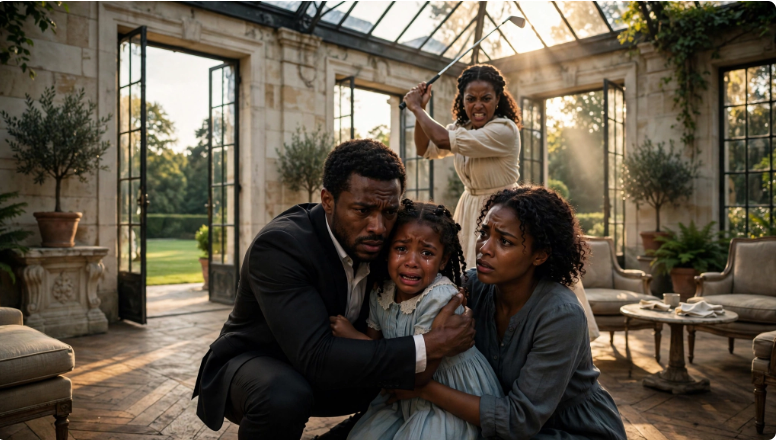
Daniel Hartley heard his daughter before he saw her.
A sharp, frightened cry came from Wrenford Hall’s orangery lounge.
He stopped outside the double doors.
The manor was normally beautiful in late afternoon.
Glass roof.
White stone.
Long windows opening toward lawns that had belonged to the Hartleys for generations.
Daniel stepped inside wearing the black suit he had worn to a financing meeting in London.
Then everything else disappeared.
Six-year-old Persephone stood in the middle of the room wearing pale blue.
She was crying so hard she could barely breathe.
Mara, Daniel’s wife, was kneeling beside her in a slate-gray blouse with both arms wrapped around their daughter.
Behind them stood Celia Hartley.
Daniel’s older sister.
Cream dress.
One of Daniel’s golf clubs raised above her shoulder.
Daniel said nothing for two seconds.
His eyes moved to the club.
Then Persephone.
Then Celia.
Celia’s expression changed.
“Daniel—”
“Put it down.”
His voice was quiet.
That made Mara look at him.
Celia lowered the club.
“I wasn’t going to hit anybody.”
Daniel crossed the room.
He crouched in front of Persephone.
“Sweetheart.”
She threw both arms around him.
He held her.
“Did anybody hurt you?”
Persephone shook her head.
“Did anybody touch you?”
Another shake.
Daniel looked toward Mara.
“What happened?”
Mara’s face remained hard.
“Ask Celia.”
Celia folded her arms.
“Your wife locked the equipment cupboard.”
Daniel looked at the golf club.
“So you decided to demonstrate why?”
“I was trying to open the latch.”
“With a seven iron?”
“I lost my temper.”
Persephone started crying harder.
Daniel immediately stopped looking at his sister.
“Sephie.”
He used the nickname only at home.
“You’re safe.”
His daughter pressed her face into his shirt.
Then whispered something.
Daniel bent closer.
“What?”
“Please don’t send me away.”
He frowned.
“I’m not sending you anywhere.”
Persephone pulled back.
Her eyes were wet.
“To St. Aldwyn’s.”
Everything inside Daniel stopped.
Mara looked at him.
“What is St. Aldwyn’s?”
Daniel did not answer quickly enough.
Mara saw it.
“You know.”
St. Aldwyn’s was a boarding school nearly three hours north.
Selective.
Expensive.
Traditional.
Daniel had toured it privately two months earlier.
He had told himself it was research.
Nothing more.
Celia spoke.
“Daniel.”
He looked at her.
She understood from his expression that silence would not protect anyone now.
“Tell Mara.”
Mara stood.
“Tell me what?”
Daniel kept one arm around Persephone.
“I visited the school.”
Mara stared.
“You did what?”
“I was considering options.”
“For our six-year-old?”
“Not immediately.”
Celia looked away.
That was another mistake.
Daniel noticed.
“What did you tell Persephone?”
His sister said nothing.
“Celia.”
She exhaled.
“I told her St. Aldwyn’s teaches children structure.”
Persephone began trembling again.
Mara’s anger sharpened.
“When?”
Celia answered reluctantly.
“More than once.”
Daniel slowly stood.
“Why would you tell my daughter that?”
“Because she has been struggling during events.”
“She is six.”
“She runs through guest areas.”
“She interrupts staff.”
“She refuses to stay in the family wing.”
Mara stared at her.
“It is her home.”
“It is also a functioning events business.”
There it was.
Wrenford Hall hosted weddings, retreats, private dinners, and luxury corporate events.
The income maintained an estate that cost hundreds of thousands of pounds each year.
Celia managed operations.
Daniel handled strategy and finance.
Mara had spent the last year watching the business invade more and more of family life.
Daniel had kept saying:
“One more season.”
Then:
“Once the new events contract is signed.”
Then:
“When staffing improves.”
Persephone whispered:
“Aunt Celia said children who can’t behave at Wrenford go to school.”
Daniel looked at his sister.
Celia’s face changed.
“I did not say it exactly like that.”
Mara answered:
“She is six. That is exactly how she heard it.”
Daniel asked Persephone:
“Did you think I was sending you away because you were bad?”
A tiny nod.
His stomach turned.
“No.”
“You are not going anywhere because you are bad.”
Then Persephone asked:
“But you already paid them.”
Mara turned.
“What?”
Daniel closed his eyes.
He had forgotten how children overheard adult telephone conversations.
Or maybe Celia told her.
It no longer mattered.
Mara’s voice became almost a whisper.
“Daniel.”
“How much?”
He looked at his wife.
“Twelve thousand pounds.”
Her face went blank.
“A deposit?”
“Refundable.”
“That is not the question.”
Daniel knew.
Celia spoke behind them.
“Don’t look at me like I invented St. Aldwyn’s.”
Daniel turned.
His sister’s face was pale now.
“You asked me to get information.”
“You toured the school.”
“And you paid to hold the place.”
The room became silent.
Daniel looked down at the child gripping his hand.
For the first time, his fury was not directed entirely across the room.
Part of it belonged to him.
THE ORANGERY, AFTER THE STORM
A Continuation
The silence that followed the revelation about the deposit did not feel like anger anymore. It felt like grief. Daniel stood in the middle of the orangery with his daughter’s small hand in his, his wife looking at him as if she were seeing a stranger, and his sister standing pale behind them. For years he had believed that keeping Wrenford Hall alive was the same as keeping his family safe. In that moment, he understood how wrong he had been.
He did not try to explain the deposit away. He did not repeat that it could be refunded, or that it was only research, or that other families did the same thing. He looked at Mara and said, simply, that he had made a decision about their daughter without her, and that he was sorry. He looked at Celia and said that she had used a frightening idea to control a frightened child, and that had to stop. And then he knelt again beside Persephone, so that his eyes were level with hers, and told her in the clearest words he could find that she was not going anywhere, that she had done nothing wrong, and that her home was here, with them, for as long as she wanted it to be.
Persephone did not stop crying at once. Children do not heal on command. But her breathing slowed, and her grip on his hand loosened just enough for him to know that she had heard him. Mara watched this, and although her face was still tight with hurt, she reached out and touched the back of Persephone’s hair, a small, instinctive gesture that told Daniel she had not closed the door on him completely.
That night, after Persephone had finally fallen asleep in her own bed with the hallway light on and her favourite blanket tucked around her, Daniel and Mara sat at the kitchen table and talked until the house was dark and quiet. It was the first honest conversation they had had in months. Mara told him that she had felt invisible in her own home, that guests were welcomed with flowers and music while their daughter was asked to be quiet, to disappear, to wait in another room. Daniel listened without interrupting, without defending the business, without turning the conversation toward money or contracts. He admitted that he had been afraid. Afraid of losing the estate his parents had left him. Afraid of disappointing the staff who depended on the events income. Afraid of admitting that the life he had built to protect his family had begun to hurt them instead.
Mara told him that fear was not an excuse for secrecy. A marriage, she said, could survive a difficult decision, but it could not survive being left out of one. Daniel agreed. He promised that from that night on, no decision about Persephone, about school, about where they lived or how they lived, would ever be made without both parents sitting down together first. It was a simple promise, but he meant it in a way he had not meant his earlier promises about one more season, or one more contract, or one more improvement that would somehow fix everything.
The next morning, Daniel did something he should have done months earlier. He telephoned the school himself, in front of Mara, and cancelled the place. He asked for the deposit to be returned in full and for Persephone’s name to be removed from their list. He did not ask them to hold it just in case. He did not leave the door open. When he put the phone down, Mara exhaled for what felt like the first time in a long while, and Daniel felt a weight lift that he had not even realised he was carrying. The money had never been the real problem. The secret had been. And now the secret was gone.
Celia’s apology came later that same day, and it was not easy for anyone. She found Persephone in the garden, where Mara was helping her plant a small row of lavender, and she knelt down, not towering over the child, not holding anything in her hands, and spoke to her directly. She said she had been wrong to talk about school in a way that frightened her. She said she had been under pressure, that the events business had made her impatient, but that none of that was Persephone’s fault, and that a child should never be made to feel that love depends on being quiet or perfect. Persephone listened, serious and thoughtful in the way only a six-year-old can be, and then she asked, very quietly, if Aunt Celia still liked her. Celia’s eyes filled with tears, and she said yes, of course, always, and that she would prove it by listening better from now on.
It took time for trust to return, and Daniel did not expect it to happen in a single afternoon. But over the following weeks, the family began to change the way Wrenford Hall worked. They sat down together, all three adults, and wrote new rules on a piece of paper that they pinned to the kitchen wall where everyone could see it. The family wing would be closed to guests during events, no exceptions. Persephone would never be asked to stay hidden because visitors were more important. No one would mention boarding school as a warning or a threat, ever again. Celia would step back from looking after Persephone during busy weekends, and a kind, experienced nanny would be there instead, so that family care and business management would no longer be tangled together. And most importantly, one weekend every month would belong entirely to the family, with no weddings, no retreats, no corporate dinners, just the three of them, and sometimes Celia, if she wanted to join them simply as a sister and an aunt, not as a manager.
Daniel also made a harder business decision. He turned down an expansion that would have brought even more events to Wrenford, even though it would have brought more money. He told his partners that the estate had to survive, but not at the cost of the childhood it was supposed to protect. Instead, he chose fewer, better events, with higher standards and longer breaks between them, and he used the extra time to be present at home. He learned his daughter’s school schedule. He attended a meeting with her teacher, and this time he listened properly when the teacher said Persephone was bright, sensitive, and happiest when she felt included. He began to walk her to the garden in the mornings before work, just to talk about ordinary things, about butterflies, about books, about what she wanted for lunch. Those small walks became the most important part of his day.
Slowly, Persephone began to change too. She stopped asking, every time Daniel picked up his suitcase, whether he was leaving for good. She stopped flinching when she heard raised voices in another room. She began to laugh loudly again in the orangery, the same room where she had once cried so hard she could barely breathe. Mara, watching her daughter chase a butterfly across the lawn one sunny afternoon, realised that the house finally felt like a home again, not a venue with a family living upstairs.
The true turning point came on Persephone’s seventh birthday. Instead of hiding her away during a large event, the family held a small garden party just for her, with fairy lights in the trees, a cake Mara had baked herself, and a special corner of the garden that Celia had helped Persephone plant with lavender and roses. Celia gave her a small wooden sign for that corner, painted in Persephone’s favourite colours, that read, in a child’s careful handwriting, Persephone’s Garden. Persephone beamed with pride and showed every guest where her flowers were growing. That evening, as the sun set over the lawns that had belonged to the Hartleys for generations, Persephone climbed into Daniel’s lap and whispered that this was the best birthday she had ever had, because everyone had stayed, and no one had asked her to disappear.
A year later, on another late afternoon in the orangery, the scene looked almost the same, and yet everything was different. The glass roof still caught the light. The white stone still glowed warm in the sun. The long windows still opened toward the lawns. But this time, Persephone was not crying in the middle of the room. She was sitting on the floor with a picture book, building a tower of cushions, laughing when it fell down. Mara was beside her, not kneeling in worry, but sitting comfortably with a cup of tea, smiling at her daughter’s games. Celia was there too, not holding a golf club, but holding a watering can, helping Persephone water the small potted plants they kept in the orangery. And Daniel, coming home from London in his black suit, stopped outside the double doors for a moment, just as he had done a year before, and listened.
What he heard was not a frightened cry. It was laughter.
He stepped inside, and Persephone ran to him, not out of fear, but out of joy, throwing her arms around him and telling him about her day at school, about the story she had read, about the flower that had finally bloomed in her garden. Daniel lifted her up and held her close, and Mara looked at him over their daughter’s head, and smiled, a real, unguarded smile that told him they had come through the hardest part together.
Later, after dinner, when Persephone was tucked into bed and the house was quiet, Daniel stood for a moment in the orangery alone. He thought about how close they had come to losing something precious, not because of a single argument or a single deposit, but because of many small silences that had added up over time. He thought about how lucky he was that Mara had spoken up, that Celia had apologised, and that Persephone had found the courage to say what she was afraid of. And he made a quiet promise to himself, not about business or money or the future of the estate, but about something much simpler: that he would keep listening, that he would keep choosing his family first, and that Wrenford Hall would always be, above all else, a home.
Persephone was safe. Mara and Daniel were partners again. Celia was family again, not just a manager. And the Hartleys, together, had learned the most important lesson of all: that a house is only truly beautiful when the people inside it feel loved, heard, and free to stay.
THE END
Leave a Reply