“Good afternoon, miss. May I clean your car window?”
That voice sounded in the middle of a busy intersection in downtown Mexico City, where honking horns, street vendors, engines, and dust mingled in a chaotic melody of daily survival.
The one who had just spoken was a thin young man with sun-tanned skin, his clothes so old they had faded. He carried a worn towel over his shoulder; in one hand he held a bottle of soapy water, and in the other, a window cleaner. The sneakers he was wearing were torn at the toes, revealing part of his fingers, but his eyes remained strangely clear.
His name was Victor.
At that intersection, people were used to seeing him from early morning until nightfall. Víctor cleaned windshields, collected plastic bottles, helped the elderly cross the street, and occasionally shared what little bread he had with the neighborhood stray dogs. Some felt sorry for him, others ignored him, and there were always those who hurled cruel words at him.
But Victor almost never got angry.
Because for him, every coin earned during the day was an opportunity to live another day.
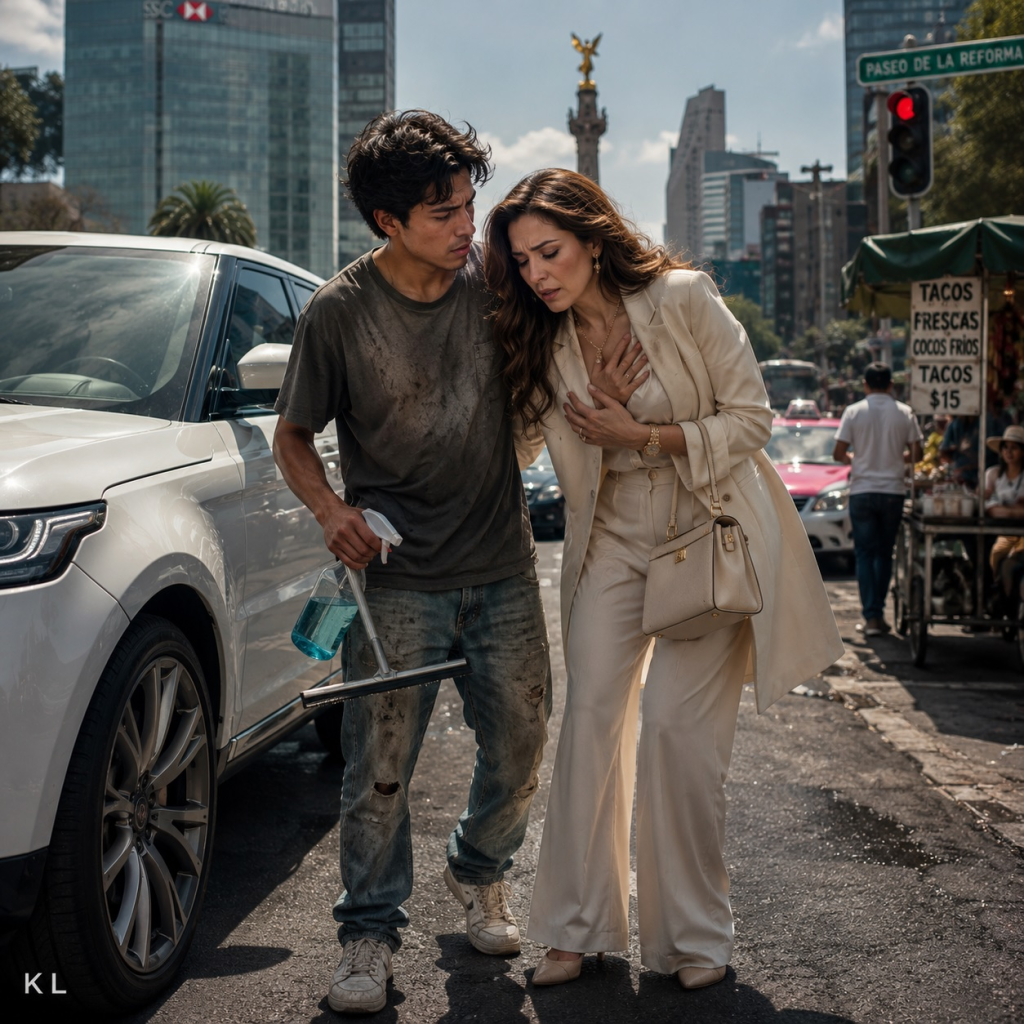
The car that pulled up in front of him that afternoon was a white SUV, so elegant it seemed out of place amidst the dust and noise of the street. Inside was a woman in her early forties, with her brown hair neatly gathered behind her neck, a delicate face, but one marked by a weariness that was difficult to conceal. She wore a simple cream-colored blouse, and around her neck she wore a small pearl necklace, nothing ostentatious, but very elegant nonetheless.
The woman rolled down the window.
“Yes please.”
Victor smiled immediately.
“Thank you, miss. I’ll do it quickly.”
He worked with great care. Unlike other windshield washers who rushed through everything just to earn a few coins, Víctor sprayed the water evenly across the windshield, wiped every corner with the towel, and gently ran the squeegee over it to avoid leaving streaks. He even cleaned the side mirrors, even though the woman hadn’t asked him to.
A moment later, he took a step back, looked at his work, and said:
“It’s all set, miss.”
The woman looked at the shiny windshield and a faint smile appeared on her lips.
“You did very well.”
She opened her bag, took out some bills, and handed them over.
“Take.”
Victor froze when he saw the amount. It was much more than people usually paid for a window cleaning. He quickly shook his head.
“Miss, this is too much. I only cleaned the windshield.”
“Don’t worry. It’s for you.”
“Thank you very much.” Victor bowed his head humbly. “Excuse me, I haven’t earned much today and I don’t have any change to give you back…”
The woman replied sweetly:
“Don’t worry. I don’t need change.”
The traffic light turned green. The cars behind began honking. The woman was about to move forward when Victor rushed in to say:
“Thank you very much, miss. God bless you.”
The woman looked at him for another second. In that instant, amidst the honking horns, the smoke, and the thick dust of the city, she felt that this simple blessing was more sincere than all the elegant congratulations she had heard at high society parties.
She smiled.
“May God bless you too.”
Then the car moved on, leaving Victor standing by the curb, clutching the bills tightly in his hand, as if he feared that, by loosening his fingers, that little dream would slip away.
That night, Victor bought a simple cake from a stall near the subway. He ate half and gave the other half to a yellowish-furred stray dog that used to follow him.
“Eat, Manchas,” she said, gently stroking his head. “We were lucky today.”
The dog wagged its tail as Victor sat on a cold step and gazed up at the Mexican night sky. The city was too big, too bright, too noisy, but to him it was also terribly lonely.
He had no home.
He had no family.
He had no one waiting for him when he returned.
At night, if the park ranger didn’t chase him away, he slept on a bench in Parque Hundido. If it rained, he took shelter under the awning of a closed shop. Some nights were so cold that he huddled up, hugging his knees, his teeth chattering, but even so he told himself:
“Just hang in there one more day, Victor. Maybe tomorrow will be better.”
A few days later, as the morning light was just beginning to fall on Insurgentes Avenue, Victor saw that white SUV again.
Her heart rejoiced, unable to contain it.
The car stopped at the side of the road, not because of the traffic light, but because the woman decided to pull over. She rolled down her window and looked at Victor.
“Good morning.”
Victor ran towards her.
“Good morning, miss. How are you?”
“I’m good and you?”
“Very well, thank you. What brings you here?”
“I’m waiting for a friend. We agreed to meet near here.”
“While you wait, would you like me to clean your car?” Victor asked, though he immediately felt a little embarrassed. “Well, only if you want me to.”
The woman let out a small laugh.
“Of course. Please help me. I haven’t had time to take it to the cleaners.”
“Yes, miss. Leave it to me.”
Victor worked as always, carefully, patiently, and without overlooking a single detail. The woman stood to the side watching him. She realized that this young man didn’t do his job haphazardly. Even though it was just cleaning a car on the street, he did it with the seriousness of someone polishing something valuable.
“What’s your name?” she asked.
Victor replied while cleaning:
“Victor. Victor Salgado.”
“I am Elsa.”
“Nice to meet you, Miss Elsa.”
“You can call me Elsa.”
Victor looked up and shook his head with complete sincerity.
“I can’t, miss. You’ve been very kind to me. I have to speak to you with respect.”
Elsa smiled, but that smile soon transformed into a thoughtful expression.
It had been a long time since anyone had spoken to him with such pure sincerity, without any hidden agenda.
In her world, people called her “Mrs. Herrera,” “President,” “Benefactor,” “Doña Elsa.” Everyone bowed their heads, smiled, shook her hand, and raised glasses in her honor, but behind every glance there was always an ulterior motive. Some wanted contracts, others favors, others status, others money.
In contrast, the poor young man in front of her just wanted to clean his car well and receive a few coins for his work.
A moment later, Victor took a step back.
“It’s all set, miss.”
Elsa looked at the shiny car and nodded.
“You were right. It turned out brilliant.”
“I told him so.” Victor smiled, revealing a set of white, slightly uneven, but very friendly teeth.
Elsa gave him money.
“You’re always so kind. Here.”
“Thanks a lot.”
“No. Thank you.”
She looked at her watch. The person she was waiting for still hadn’t arrived.
Victor lowered his head and was about to leave, but Elsa suddenly called him:
“Victor.”
“Yes, miss?”
“My friend looks like he’s going to be a while. Do you mind if I sit with you for a bit?”
Victor was so surprised that he didn’t know what to say.
On that street, people could call him over to clean a window, give him money, or shoo him away with a dismissive gesture. But almost no one wanted to sit next to him.
He looked at his old shirt, his hands stained with soap and dust, and said awkwardly:
“It doesn’t bother me, miss… but it’s dirty in here. It’s not a comfortable place for you.”
Elsa said nothing. She just took a napkin from her bag, placed it on the cement edge next to the bench, and sat down.
Victor felt even more confused.
“You really don’t have to do that.”
“I want to do it.”
She opened a paper bag she was carrying. Inside were two cakes and juice.
“I bought too much. Eat with me.”
“No, miss. I…”
“Here. Seriously, you must be hungry. It’s late.”
Victor swallowed hard. His stomach had been burning with hunger since morning, but he still tried to say:
“Yes… but I’m going to have breakfast later. Don’t worry.”
Elsa placed the cake in his hands.
“Take it.”
Victor looked at the still-warm cake. The smell of the grilled meat and avocado wafted up to his nose, making his eyes water.
“Thank you, miss.”
The two sat down to eat by the sidewalk. A rich, elegant woman, and a poor young man who cleaned windshields on the street. Passersby looked at them strangely. Some frowned, others murmured. But Elsa didn’t seem to care about any of it.
“Victor,” she asked, “how long have you been doing this job?”
“Since I was fourteen years old.”
“You were very young.”
“Yes. But on the street, young or old, you have to find a way to eat.”
Elsa remained silent.
That phrase sounded light, but it struck her heart like a stone.
“Do you have a family?”
Victor’s smile gradually faded.
“No, miss,” he answered softly. “My parents died when I was a child. Then I lived with an uncle for a while, but after a month he kicked me out of his house. He said he barely had enough to feed his own children and that I was just another burden.”
Elsa stopped eating.
Victor didn’t say it with anger. Not even with open sadness. He said it like someone announcing that it’s going to rain, as if life had forced him to make pain a habit.
“I’ve been living on the streets ever since,” he continued. “At first it was very difficult. I didn’t know where to sleep, or how to get food. My shoes were stolen once. Another time I went two days without eating anything. But you learn, miss. You learn where not to go, who not to look in the eye, when to run and when to keep quiet.”
Elsa felt something tighten in her chest.
“And friends?”
Victor let out a small, almost embarrassed laugh.
“Friends? Nobody wants to be friends with a window cleaner.”
“Yes, I do,” Elsa said immediately.
He looked up, confused.
“You?”
“Yes. Me.”
Victor didn’t know what to answer. He stared at the cake in his hands, as if it suddenly weighed more than a stone.
Elsa spoke with a gentleness that needed no embellishment.
“Don’t ever say you’re just a window cleaner again. That’s your job now, not your destiny. There’s a huge difference between what you do to survive and what you can become when someone gives you a chance.”
Victor swallowed hard.
“Nobody gives opportunities to people like me.”
“So perhaps it’s time for that to change.”
He tried to smile, but his eyes began to glow.
“You speak beautifully, Miss Elsa.”
“I don’t talk nicely. I’m serious.”
Evening was falling over Mexico City. The buildings reflected a murky golden light, the vendors were slowly packing up their stalls, and the traffic continued to roar like a weary beast. But in that small corner of the sidewalk, for a few minutes, the world seemed to turn down the volume.
Elsa then asked him:
“Do you have any dreams, Victor?”
He remained silent for so long that Elsa thought he wasn’t going to answer.
Then he said:
“Yeah.”
“Which?”
Victor took a deep breath.
“I want to study medicine.”
Elsa opened her eyes in surprise.
“Medicine?”
“Yes. I know it sounds ridiculous.”
“It doesn’t sound ridiculous.”
“It does sound like it,” he said, looking down. “A kid who sleeps on a bench, who didn’t finish high school, who cleans windshields at a traffic light… how can he be a doctor?”
“Why do you want to be one?”
Victor squeezed the napkin between his fingers.
“Because my mom died waiting for care. She got very sick one night. I was little, but I remember her chest hurting a lot. My dad went out to ask for help, but nobody wanted to take us to the hospital because we didn’t have any money. When we finally got someone to give us a ride, it was too late.”
Elsa put a hand to her mouth.
“Very sorry.”
“From that day on, I thought that if I could ever be a doctor, I would never leave anyone out just because they don’t have money.”
The words hung suspended between the two.
Elsa had met brilliant businesspeople, influential politicians, famous doctors, and young heirs who spoke of success with pride. But she had never heard such pure ambition as that.
Victor didn’t want to be a doctor to get rich.
He wanted to be a doctor because one day he had been a helpless child watching his mother fade away.
“Victor,” Elsa said, in the firmest voice she could muster, “I believe you can do it.”
He let out a sad laugh.
“Thank you for saying so, miss. But some dreams are only meant to be admired from afar.”
“No. Some dreams wait for the right moment.”
Victor was about to answer, but Elsa suddenly froze. Her face paled. Her fingers closed on the cement table.
“Miss Elsa?”
She tried to breathe, but the air seemed to get stuck in her throat.
“I… I’m sorry…”
“What’s wrong with him?”
Elsa put her hand to her chest. Her eyes filled with fear.
“I can’t… I can’t breathe…”
Victor stood up suddenly.
“Miss Elsa!”
She leaned forward, trembling. The paper bag fell to the floor. The juice spilled onto the sidewalk.
“It hurts here…”
Victor felt his blood run cold. He had seen fear in the eyes of many people on the street, but Elsa’s was different. It was the fear of someone who knew exactly what might be happening.
“Help!” Victor shouted. “Someone call an ambulance!”
Several people watched. Some approached. Others just took out their cell phones. Traffic was at a standstill, cars were piled up, and horns were blaring relentlessly.
Victor understood that waiting could cost him his life.
Without thinking, he grabbed Elsa by the shoulders.
“Miss, listen to me. Don’t fall asleep. Look at me.”
She could barely keep her eyes open.
“Victor…”
“I’m here. I’m not going to leave her.”
A taxi driver stopped a few meters away. Victor ran towards him.
“Please, to the hospital! He’s very ill!”
The driver looked at Elsa, then at Victor.
“Do you have money?”
Victor emptied his pockets. A few crumpled bills, coins, almost nothing.
“I have this. I swear I’ll pay you the rest. I work here every day. Ask for me. But please take us.”
The taxi driver hesitated.
Victor, in despair, removed a small, rusty chain he wore around his neck. It had an old medal of the Virgin of Guadalupe on it.
“It belonged to my mom,” he said, his voice breaking. “It’s all I have left. Keep this, but please help me save her.”
The taxi driver’s face changed.
“Get in.”
Victor carried Elsa as best he could. His thin arms trembled, but he didn’t let go of her. All the way to the Ángeles del Pedregal Hospital, he talked to her nonstop.
“Breathe with me, miss. That’s it. Don’t close your eyes. You told me I had potential, remember? Well, now I’m telling you that you have to hang in there. You still have to see me in a white coat.”
Elsa, between the pain and the lack of air, tried to smile.
“Promise me… that you will never stop dreaming…”
“I promise you, but you also have to promise me that you will be saved.”
She couldn’t answer.
Upon arriving at the hospital, Víctor rushed in screaming for help. The doctors put her on a stretcher and took her to the emergency room.
“Are you a relative?” a nurse asked.
“No. I’m his friend.”
The nurse looked him up and down. She saw his worn clothes, his dirty hands, his face drenched with sweat and fear.
“Wait here.”
The doors closed.
Victor was left alone in the hallway, his hands trembling and his heart pounding in his ribs.
Twenty minutes passed.
Then forty.
Then an hour.
An elegant man arrived almost running, though his concern seemed more annoyance than distress. It was Marcelo, Elsa’s friend, the same one who had humiliated him days before.
“Where is Elsa?” he demanded.
Victor got up.
“She’s in the emergency room. She got sick. I brought her here.”
Marcelo looked at him with contempt.
“You again?”
“Sir, she couldn’t breathe. I just…”
“What did you do to him?”
Victor took a step back.
“Nothing. I was eating with her and suddenly…”
“Eating with you?” Marcelo let out a dry laugh. “This is the last straw.”
Before Victor could answer, the doctor appeared.
“Relatives of Mrs. Elsa Herrera?”
“I am her fiancé,” Marcelo said quickly.
Victor froze. Elsa had never told him that Marcelo was her fiancé.
The doctor spoke seriously.
“Mrs. Herrera suffered a heart attack. Fortunately, she arrived in time. If she had been a few minutes late, the outcome would have been very different.”
Victor felt his legs giving way.
“Is he going to live?”
The doctor looked at him.
“For now, he’s stable. But he needs complete rest, tests, and monitoring. His heart is delicate.”
Marcelo sighed in annoyance.
“When can he go home?”
“Not soon.”
“Doctor, I have an important trip tomorrow. I need to organize this.”
Victor looked at him, incredulous.
“Organize this? She almost died and you’re thinking about a trip?”
Marcelo turned towards him with his eyes full of fury.
“You shut up. You’re nobody.”
The doctor intervened.
“The young man was the one who brought her in. According to the admissions staff, he also insisted that she be seen immediately. That saved her life.”
Marcelo clenched his jaw.
“Very good. You’ve done your good deed for the day. Now you can go.”
“No,” Victor said. “I want to know how she is. I want to see her, even if it’s just for a minute.”
“You’re not getting in.”
“She is my friend.”
Marcelo approached him and lowered his voice.
“Listen carefully, window cleaner. Elsa felt sorry for you, nothing more. Don’t confuse pity with friendship. You and she don’t belong to the same world.”
Victor felt the blow of those words, but this time he did not lower his head.
“Maybe I don’t belong in her world,” he replied. “But when she needed help, I was the one who was there.”
Marcelo raised his hand as if he were going to push him, but the doctor took a step forward.
“Sir, this is a hospital. If you want to argue, do it outside.”
Marcelo took a deep breath, adjusted his jacket, and pointed at Victor.
“Get him out of here.”
Hospital security approached. Victor didn’t resist, but before leaving he glanced down the corridor where Elsa had been taken.
“Tell her I was here,” she asked the nurse. “Please.”
The woman made no promises, but her eyes softened.
Victor spent the night outside the hospital, sitting on a planter, hugging his knees. The city was still alive around him, but all he could think about was Elsa.
When dawn broke, a nurse came out with a glass of coffee and a sweet roll.
“For you,” he said.
Victor looked up.
“Is she okay?”
“He woke up a little while ago.”
He stood up immediately.
“Can I see her?”
The nurse hesitated.
“Her fiancé doesn’t want to.”
Victor felt a pang in his chest.
“I understand.”
The nurse added in a low voice:
“But he asked about you.”
Victor closed his eyes.
That was enough to keep him from collapsing.
For the next few days, Elsa remained hospitalized. Marcelo controlled the visits, the calls, and even the flowers that arrived in her room. He said he was doing it for her health, but in reality, he feared something he couldn’t control: Elsa’s gratitude toward that poor boy.
What Marcelo didn’t know was that Elsa had heard enough.
From her bed, weak but lucid, she had asked the nurse who had paid for the taxi, who had run for help, who had begged for her to be seen. And every answer bore the same name.
Victor.
When Oscar, her lawyer and trusted confidant, went to see her, Elsa asked him to close the door.
“I need you to do something for me.”
“Whatever you say, Mrs. Herrera.”
Elsa looked out the window. The afternoon light fell on her tired face.
“Marcelo doesn’t love me. He loves my last name, my companies, and my money.”
Oscar remained silent. It wasn’t the first time he’d thought about it.
“I want to cancel the engagement.”
“Are you sure?”
“Safer than ever.”
“That will cause problems.”
Elsa smiled weakly.
“Oscar, I’ve lived surrounded by problems wrapped in silk my whole life. They don’t scare me anymore.”
Then he took a breath with difficulty.
“I also want to change my will. But not because I think I’m going to die tomorrow. I want to change it because I finally understand what I want to do with my life if I survive.”
Oscar leaned towards her.
“Tell me.”
“I want to find Victor. I want to give him a real chance. Not handouts. Not empty charity. A chance.”
“What are you thinking about?”
Elsa looked at her hands, still marked by the needles from the hospital.
“A house. Studies. Legal protection. And then… a foundation.”
Oscar blinked.
“A foundation?”
“Yes. A clinic for people who can’t afford it. Victor wants to be a doctor. I want to help him get there. And when he gets there, I want that dream to be bigger than both of us.”
For the first time in many years, Oscar saw something other than tiredness in Elsa’s eyes.
He saw purpose.
Three weeks later, Elsa left the hospital.
Marcelo was waiting for her at the door with a calculated smile, an extremely expensive bouquet of flowers, and a cold kiss on her cheek.
“My love, finally. Let’s go home. We have a lot to talk about.”
Elsa did not take his arm.
“Yes, Marcelo. We have a lot to talk about.”
He didn’t notice the tone of her voice.
That night, at the mansion in Lomas de Chapultepec, Marcelo served wine as if nothing had happened. Elsa didn’t drink it. She sat across from him, holding an envelope.
“I’m going to cancel our engagement.”
Marcelo remained motionless.
“That?”
“You heard it.”
“Elsa, you’re confused. The hospital, the scare…”
“I’m not confused. On the contrary. It’s been years since I’ve seen things so clearly.”
Marcelo slammed the glass down on the table.
“Is it because of that boy?”
“It’s because of me.”
“For you?”
“Yes. Because I almost died and all you thought about was your schedule. Because a poor stranger did for me what you, being my fiancé, weren’t able to do. Because when I woke up, the first thing you asked was when I could go home, not how I felt.”
“You’re exaggerating.”
“No. I’m waking up.”
Marcelo’s expression changed. The friendly mask cracked.
“You can’t do this to me. You know how much I’ve invested in this relationship.”
Elsa looked at him sadly.
“Thanks for putting it that way. Inverted. That word explains everything.”
Marcelo approached her.
“If you break up with me, you’ll regret it.”
Elsa did not back down.
“No, Marcelo. I regret not having done it sooner.”
The next day, the news spread through social circles. Elsa Herrera had called off her engagement. Marcelo, furious, began to spread rumors. He said Elsa was mentally ill, that a street urchin had manipulated her, that her lawyer was taking advantage of her.
But Elsa did not respond with scandals.
He responded with actions.
One morning, Victor was on his usual corner, cleaning a taxi windshield, when a black car pulled up in front of him. Oscar got out, impeccably dressed, serious, with a folder under his arm.
“Victor Salgado?”
Victor stiffened.
“Yes. Is something wrong? Is Miss Elsa alright?”
“She’s alive. And she wants to see him.”
Victor’s eyes filled with light.
“Really?”
“Really.”
“Now?”
“Now.”
Victor looked at his clothes, his dirty hands, his torn sneakers.
“I can’t go like this.”
Oscar barely smiled.
“Mrs. Elsa said you would probably say that. She also said that if you were the same young man who ran to save her, then you were perfectly dressed.”
Victor got into the car with his heart pounding in his chest.
The car took him to a house in Coyoacán. It wasn’t a cold mansion, but a spacious, bright house with bougainvillea at the entrance and a patio full of potted plants. Elsa was sitting in a chair by the window. She looked thinner, but her eyes had regained some of their sparkle.
“Victor,” she said upon seeing him.
He stood in the doorway, unable to move.
“Miss Elsa…”
She extended a hand.
“Come.”
Victor approached slowly. When he was in front of her, he lowered his head.
“Forgive me. I wanted to stay in the hospital, but they wouldn’t let me.”
Elsa squeezed his hand.
“You have nothing to apologize for. You saved my life.”
“I just did what anyone would have done.”
“No. A lot of people watched. You acted.”
Victor didn’t know what to say.
Elsa pointed to the chair in front of her.
“Sit down. We need to talk about your future.”
“My future?”
“Yeah.”
Oscar left the folder on the table.
Elsa took a deep breath.
“Victor, I bought this house for you.”
The young man froze.
“No… I don’t understand.”
“This house is yours. Legally. It’s already in your name, thanks to Oscar’s help.”
Victor stood up suddenly.
“No, miss. I can’t accept that.”
“Yes you can.”
“No. It’s too much. I didn’t do anything to deserve a house.”
Elsa looked at him with a firmness that allowed no escape.
“You slept on park benches for years. You survived without stealing, without becoming cruel, without ceasing to help others even when you had nothing. And you still think you don’t deserve a roof over your head?”
Victor opened his mouth, but no words came out.
“Besides,” she continued, “I’m not buying you. I’m not paying you. I’m giving you back an opportunity that life stole from you too soon.”
He began to shake his head, his eyes filled with tears.
“Miss Elsa…”
“There’s also a bank account for your studies. You’re going to finish high school. Then you’re going to take the entrance exam for medical school. And if you accept, Óscar will take care of helping you with the whole process.”
Victor put both hands to his face.
“I don’t know if I can.”
Elsa smiled.
“I do know.”
“What if I fail?”
“Then you try again.”
“What if people make fun of you?”
“Let them laugh. Nobody builds a new life with the opinions of those who never offered a helping hand.”
Victor fell to his knees beside her and burst into tears.
Elsa stroked her hair tenderly.
“Listen to me carefully, Victor. You are not my debt. You are my friend. And friends are not abandoned on the sidewalk.”
That day, Victor entered for the first time the house that would be his home.
There was a clean bed, a bathroom, a small kitchen, a study table, and a bookcase full of new books. In the yard, Manchas ran around happily because Elsa had also asked to be taken there.
On the table was a handwritten card:
“So that you can start from here. Not from scratch, but from hope.”
Victor read it so many times that he ended up memorizing it.
The following months were not easy.
Having a house didn’t instantly erase the years of hunger, fear, and abandonment. At first, Víctor couldn’t sleep in the bed. He would lie down for a while and then get up to check the door, the windows, the yard. Sometimes he would sit on the floor next to Manchas because a part of him still believed that someone would come and tell him that it had all been a mistake.
Elsa understood.
She visited him every week, always accompanied by Óscar or her nurse. She wasn’t there to watch over him. She was there to remind him that this new life was real.
“Did you sleep in bed yet?” he asked her one afternoon.
Victor looked away.
“A bit.”
“How much is a little?”
“Twenty minutes.”
Elsa let out a soft laugh.
“Well, it’s a start.”
He smiled sheepishly.
“It feels strange.”
“The good things can also feel strange when you’re not used to them.”
Victor started studying again in an adult education program. At first, it was extremely difficult for him. He had forgotten formulas, dates, and grammar rules. In class, some students looked at him with disdain for being older than the others.
But every time she wanted to give up, she opened the notebook where she had written a phrase from Elsa:
“Your current job is not your destiny.”
I read it and followed it.
Elsa, for her part, also changed.
After the heart attack, he scaled back his businesses, sold properties he never used, and distanced himself from the salons where everyone smiled with glass teeth. Together with Óscar, he founded an organization called “Open Doors,” dedicated to providing medical care and scholarships to homeless youth.
When the press asked her why she did that, Elsa replied:
“Because one day I almost died on a bench, and the person who saved me was someone many would have preferred not to look at.”
Victor’s story began to circulate. Some media outlets wanted to turn it into a spectacle. They waited for him outside the school, followed him in the street, and wanted photos of “the window washer who inherited a house.”
Victor got scared.
“I don’t want everyone talking about me,” he told Elsa.
“Then don’t give them your soul. Just give them a truth.”
“Which?”
“You don’t want fame. You want to study.”
And that’s what he did.
When a reporter asked him if he now felt rich, Victor replied:
“No. I feel responsible.”
That phrase appeared in many headlines.
Marcelo, meanwhile, couldn’t bear the humiliation. He tried to sue Elsa, claiming that her illness had made her vulnerable. But the documents were in order. Doctors confirmed that Elsa was fully competent. Furthermore, Óscar presented recordings in which Marcelo spoke about Elsa’s fortune as if it already belonged to him.
His reputation plummeted.
The same social circles that had once welcomed him with smiles began to close their doors to him. Marcelo ended up leaving the city, pursued not by poverty, but by something worse for him: irrelevance.
Victor did not celebrate his fall.
“I’m not happy about it,” he told Elsa.
“That speaks well of you.”
“I just hope that one day he’ll understand.”
Elsa looked out the window.
“Some people only understand when life takes away the mirror in which they admired themselves.”
Years passed.
Victor graduated high school with honors. On the day of the ceremony, Elsa attended in a dark blue dress and carried an elegant cane. She was more frail, yes, but also more vibrant than before. When Victor Salgado’s name was called, she stood with difficulty and applauded louder than anyone else.
Victor came down from the stage and handed him the diploma.
“This is yours too.”
Elsa shook her head.
“No. It’s yours. I just opened a door. You walked right through.”
Then came the medical school entrance exam.
Victor studied as if each page were a brick in his future. There were nights when he fell asleep on top of his books. Manchas rested his head on his feet, faithful as a small, furry guardian. Elsa sent him short messages:
“Breathe.”
“Eat something.”
“You are not a machine.”
“The world needs doctors with heart, not students who are dead tired.”
The day the results arrived, Victor didn’t dare open the page.
Elsa was with him in the living room.
“Do it,” she said.
“Can’t.”
“Yes you can.”
“What if I didn’t get in?”
“Then we cry for ten minutes, eat sweet bread, and make a new plan.”
Victor looked at her.
“You always have a plan.”
“Of course. That’s what stubborn women are for.”
He let out a nervous laugh and opened the page.
He looked up her name.
Once.
Twice.
And then he saw it.
Victor Salgado. Accepted. Faculty of Medicine.
The silence lasted only a second.
Then Victor covered his mouth with both hands and began to cry.
Elsa cried too.
Oscar, who was pretending to read some papers in the corner, took off his glasses and looked up at the ceiling to hide his tears.
“You did it,” Elsa whispered.
Victor knelt in front of her, just like that first time in the house.
“No. We did it.”
The race was tough. Tougher than Victor had imagined.
There were endless classes, practicals, exams, enormous books, words that seemed designed to break anyone’s tongue. Some classmates respected him. Others looked down on him.
“Are you the famous window cleaner?” a girl once asked him, with a cruel smile.
Victor closed his book and calmly replied:
“Yeah.”
“What an inspiring story. I guess we all have to feel sorry for you now.”
He looked at her without anger.
“No. You just have to study. Just like me.”
The girl didn’t know what to say.
Over time, many stopped making fun of him. Not because Víctor begged for respect, but because he earned it through discipline. He was the first to arrive, the last to leave, the one who explained things to his classmates, the one who treated patients with the most patience during clinical rotations.
An elderly professor, Dr. Ramírez, observed him after a consultation with an Indigenous woman who barely spoke Spanish. Víctor didn’t rush her, didn’t make her feel ignorant, didn’t treat her as a problem. He found an interpreter, spoke to her respectfully, and explained each step.
When he finished, Dr. Ramirez said to him:
“Salgado, you have something that isn’t taught at university.”
“What is it, doctor?”
“Humanity. Don’t lose it. Medicine without it is just mechanics in a white coat.”
Victor kept those words along with Elsa’s.
The years went by.
Elsa had relapses. Some nights she ended up back in the hospital. But this time she wasn’t alone. Victor would visit her after class, bring her notes to study with, tell her stories from college, and check her medications with a seriousness that made her laugh.
“You’re not my doctor yet,” she joked.
“But I practice with you.”
“What an honor to be your first difficult patient.”
“My favorite patient.”
Elsa slowly improved. She didn’t regain perfect health, but she did find a life with meaning. The foundation grew. They opened soup kitchens, established partnerships with clinics, and offered scholarships for homeless youth. The house in Coyoacán became a meeting place on Sundays for volunteers, students, and children who needed academic support.
Victor no longer slept under the stars because he had no roof over his head. Now he looked at them from the patio, next to Elsa, while Manchas snored on a blanket.
One night, Elsa asked him:
“Do you miss the street?”
Victor thought before answering.
“I don’t miss the hunger or the cold. But I don’t want to forget.”
“Because?”
“Because if I forget, I could become like the people who passed by me without seeing me.”
Elsa nodded.
“So don’t forget. But don’t live chained to pain either. Use it as a compass, not as a prison.”
Victor looked at the sky.
“You speak beautifully, Miss Elsa.”
She smiled.
“And you keep saying the same thing after all these years.”
Finally, graduation day arrived.
The Faculty of Medicine was filled with families, flowers, cameras, and excited voices. Victor put on his gown with trembling hands. In front of the mirror, for a moment he saw the boy with the torn sneakers, holding the soapy water bottle. Then he saw the man who stood there now.
It didn’t feel any different.
He felt complete.
When they announced his name, the auditorium erupted in applause.
“Víctor Salgado Herrera Foundation Scholar, Doctor of Medicine.”
Elsa stood up with Oscar’s help. She clapped through her tears, not caring that her makeup was running. Victor, from the stage, searched for her in the crowd and, finding her, placed a hand over his heart.
After receiving his degree, he was asked to say a few words.
Victor approached the microphone.
For a moment, he couldn’t speak.
Then he took a deep breath.
“Years ago, I cleaned windshields at a traffic light on Avenida Insurgentes. I slept on a bench in Parque Hundido and thought my greatest luck was earning enough money to eat once a day.”
The audience remained silent.
“One day, a woman stopped. She could have seen me as a nuisance, as part of the scenery, as someone invisible. But she didn’t. She looked at me the way you look at a human being. She sat with me on the sidewalk. She shared her food. She listened to my story. And when her life was in danger, I did the only thing I could do: try to save her.”
He looked at Elsa.
“She says I saved her life. But the truth is, she saved mine in a much deeper way. She gave me a roof over my head, an education, and support. But above all, she gave me back the ability to believe in myself.”
Victor lifted the title.
“This paper bears my name, but it also belongs to all those who were once invisible. To the children who sleep on the streets. To the mothers who wait for medical care without money. To the elderly whom no one listens to. To the young people who believe their dreams are too big for their pockets.”
Her voice cracked slightly.
“And it belongs to Elsa Herrera, my friend, my chosen family, and the first person who told me that I wasn’t just a window cleaner.”
The applause came like a wave.
Elsa was crying openly.
That night, at the house in Coyoacán, they had a simple dinner. There were no absurd luxuries, no guests with fake smiles. Just Óscar, some volunteers, Víctor’s colleagues, children from the foundation, and Elsa, sitting at the head of the table like a tired but burning lighthouse.
Victor handed him a small box.
“It’s for you.”
Elsa opened it. Inside was the old medal of the Virgin of Guadalupe that Víctor had given to the taxi driver years before. Óscar had recovered it some time later, following the trail of that driver.
Elsa took it carefully.
“Victor…”
“It belonged to my mother. I used it to try to save you. I believe it should now stay with the person who helped save me.”
Elsa closed her hand over the medal and hugged him.
“I couldn’t receive anything more valuable.”
A year later, in a humble neighborhood in the east of Mexico City, the Elsa Herrera Open Doors Clinic opened its doors.
There was a simple sign at the entrance:
Here, no one will be turned away for not having money.
Dr. Victor Salgado arrived before everyone else on the first day. He put on his white coat, adjusted his name tag, and walked through the still-empty hallways. The air smelled of fresh paint, disinfectant, freshly brewed coffee, and hope.
Elsa arrived shortly afterwards in a wheelchair, on medical advice, although she insisted that she could walk.
“Miss Elsa,” Victor said, bowing to her, “welcome to your clinic.”
She looked at the building, the rooms, the consulting rooms, the volunteers preparing files.
“No,” she replied with a smile. “Welcome to our dream.”
The first patient was a feverish child, the son of a street vendor who couldn’t afford a doctor’s appointment. The woman entered fearfully, clutching her hat in her hands.
“Doctor, I don’t have much to pay…”
Victor crouched down in front of the boy and smiled at him.
“So let’s start with the important stuff. What’s your name, champ?”
The woman burst into tears.
Elsa watched from the doorway.
At that moment he understood that it had all been worth it. The pain, the illness, Marcelo’s betrayal, the nights of uncertainty, everything had led to that instant: a poor child being treated with dignity by a doctor who had once also been invisible.
Years later, the clinic became a care network for vulnerable communities. Víctor trained new doctors. Many of them came from poor neighborhoods, from families without resources, with painful histories. He always told them the same thing on their first day:
“The white coat doesn’t make them superior to anyone. It only reminds them that they have a greater responsibility.”
Elsa lived long enough to see Víctor become the foundation’s medical director. She lived long enough to see him legally adopt Manchas as the clinic’s “honorary founding dog.” She lived long enough to see him receive awards that he accepted with discomfort, always saying:
“Give the award to the clinic, not to me.”
And above all, she lived long enough to see him happy.
Not happy like in fairy tales where all pain disappears, but happy in that profound way where a wound becomes a path.
One afternoon, many years after that first encounter at the traffic light, Elsa and Víctor returned to Avenida Insurgentes. She insisted on going. She wanted to see the place where it had all begun.
The intersection was still noisy. Horns were still honking. Vendors were still offering candy, flowers, and bottled water. On one corner, a teenager was cleaning windshields with an old bottle and a towel over his shoulder.
Victor watched him in silence.
The boy approached a car and was yelled at. He lowered his head, just as Victor had done so many times.
Elsa touched Victor’s hand.
“Do you see it?”
“Yeah.”
“Then you know what to do.”
Victor smiled.
He got out of the car, walked over to the boy, and bought a bottle of water from the nearest vendor.
“Hello,” she said. “What’s your name?”
The young man looked at him suspiciously.
“Matthew.”
“Have you eaten yet, Mateo?”
The boy hesitated.
“No.”
Victor offered him the bottle.
“Come. There’s a clinic nearby. There’s also food, books, and people who can help you if you want.”
Mateo frowned.
“Why would he help me?”
Victor looked towards the car, where Elsa was watching him with eyes full of tenderness.
“Because one day someone did the same for me.”
Mateo took the bottle, still suspicious, but with a small spark in his eyes.
And at that moment, Victor understood that the true way to show gratitude was not to look back with nostalgia, but to extend a hand forward.
Elsa had not only given him a house.
I had given him a mission.
Not only had his life changed.
He had taught her how to change others.
From that day on, the clinic had a special program for street youth. It was called “From the Sidewalk to a Dream.” It helped them finish their studies, obtain documents, receive medical care, psychological support, and scholarships. Mateo was the first to enroll.
Years later, Mateo became a nurse.
And when someone asked him why he chose to care for patients, he would reply:
“Because a doctor saw me when I thought I was invisible.”
And so, Elsa’s kindness continued to travel. It went from a wealthy woman to a window washer. From a window washer to a street child. From that child to hundreds of patients. And then to thousands.
Like a small light that doesn’t go out, but learns to multiply.
Victor never stopped keeping the first window cleaner he ever used in his office. He had it framed next to a photograph of Elsa smiling under the bougainvillea in Coyoacán.
Below he wrote a sentence:
“No one is merely what the world sees from afar.”
And every time someone entered his office ashamed because they couldn’t pay, afraid of being rejected, with the downcast eyes of someone who had been humiliated too many times, Dr. Victor Salgado remembered the boy he once was.
Then he would get up, open the door, and say:
“Come in. We can see it here.”
Because one afternoon, amidst the brutal noise of Mexico City, a rich woman decided to really look at a poor young man.
And that young man, when he had the opportunity, decided to save her.
She returned the gesture in a way no one expected: not with a simple reward, but with an entire future.
A roof.
A career.
A chosen family.
A clinic.
A new life.
And Victor, who had once slept under the stars because he had no home, ended up becoming the star that lit the way for many others.
This is how a street window washer saved a millionaire.
And that’s how her gratitude changed not only his life, but that of an entire city that, little by little, learned to see the invisible.
Leave a Reply