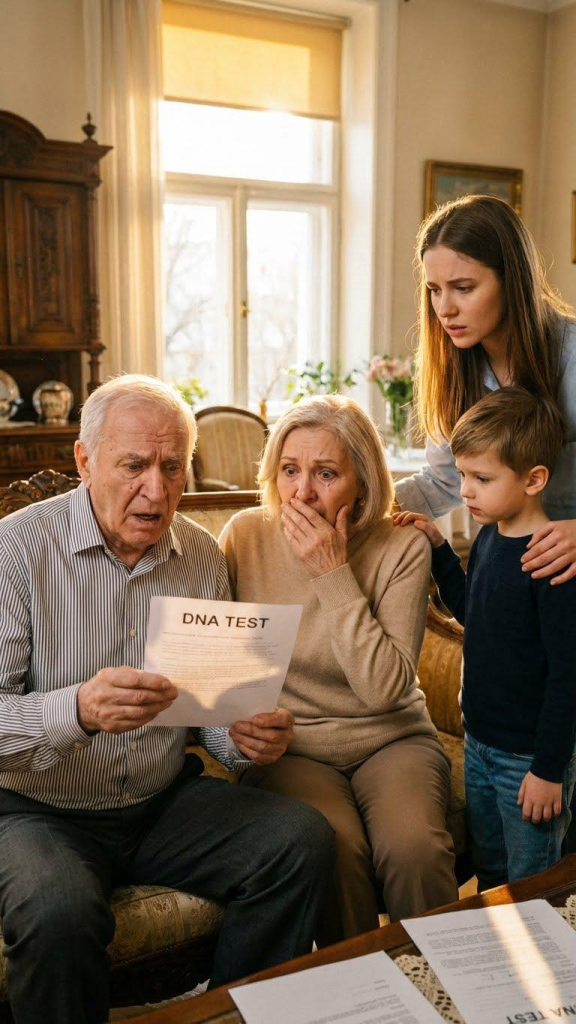
The first time I brought my son back to the house that exiled us, the air itself turned against me. My parents stared at him like he was a curse with my eyes, a living reminder of everything they’d tried to bury under polished floors and polite lies. Ten years of silence pressed on my chest, thick and unbreathable, as my boy’s fingers tightened around mine. They thought he was my shame, the evidence of my ruin. They didn’t know he was their belo…
Belonging. The word snagged in my throat as my mother’s gaze flicked from his face to the family portraits lining the hall, counting bloodlines and timelines like a silent accusation. My father’s jaw locked when I spoke his name—Eli—and then, before they could twist the story again, I dropped the other name like a stone into still water: Robert Keller. The crystal on the sideboard trembled in my mother’s hand. Not a stranger, not a rumor, but the man they’d toasted at Christmas, the man whose signature sat beside my father’s on every deal that built this house. The same hands that signed contracts with my father had pinned me in the darkened library while laughter and crystal clinked on the other side of the wall. My son’s existence cornered them, forced their eyes open to the crime they had hosted, defended, and then quietly era…
My father was the first to break. Not with tears—those came later, in private—but with a question that wasn’t really a question: “Why didn’t you tell us it was him?” The old script rose in my throat—you wouldn’t have believed me—but I swallowed it. This time I did not argue for my own reality. I laid it out, piece by piece: the party, the library door that didn’t quite close, the dress I never wore again. My mother flinched at details she’d once dismissed as “misunderstandings,” her fingers twisting the hem of a dish towel until the seams threatened to give. When I finally said the word they’d spent a decade avoiding, the room went so quiet I could hear Eli’s breathing behind me, steady and small and impossibly brave.
Healing didn’t arrive as a grand confession or a perfectly worded apology. It came in fragments: my father’s first unsteady admission that he should have asked different questions, listened harder, believed sooner; my mother quietly boxing up Keller’s framed awards and carrying them to the trash herself. Eli, with a patience he never owed them, let them earn each inch back—one board game at the kitchen table, one shared joke in the driveway. I never recovered the years taken from me, the girl I might have been in a house that chose me over its reputation. But I claimed something larger: the right to name what happened, to love my child without apology, and to stand in those rooms without shrinking. In the end, that truth was the only legacy I refused to let them rewrite, and the only inheritance I wanted my son to carry forward.
Leave a Reply